
Dundy County Court Record Requests
Begin with the court level. Dundy County Court handles traffic, misdemeanor, infraction, probate, small-claims, juvenile, and preliminary-hearing files. Dundy District Court holds district criminal cases after bind-over, district civil and domestic matters, protection orders, and appeals from county court. For a first look, JUSTICE Search gives the public case information, a register of actions, and any images the system carries. Not every document makes it online, though.
For anything the search cannot show, use the courthouse counter or the public terminal. Call the clerk to confirm which court holds the file. That also tells you whether it is available. Mail a written request only if the clerk tells you to. The official Dundy listing posts no direct court email. When you need file copies or certified copies from either court, the statewide CC 3:29 file-copy request form is the right one. Send it to the local court, though, not the forms-help address.
- Record the court level, full case number, case type, filing year, and exact document or register entry sought.
- Use JUSTICE to locate public summary information, the register, and any image that the system makes available.
- Visit the Dundy courthouse terminal or counter when a paper file, local check, or staff-directed access is needed.
- Call the clerk before travel or a directed mail request to verify the record, copy type, and current fee.
- Use CC 3:29 when directed, and state whether a plain or certified copy is wanted.
Need a file copy or a certified copy of Dundy County court records? The official file-copy request listing shows the statewide route that covers county and district court records.
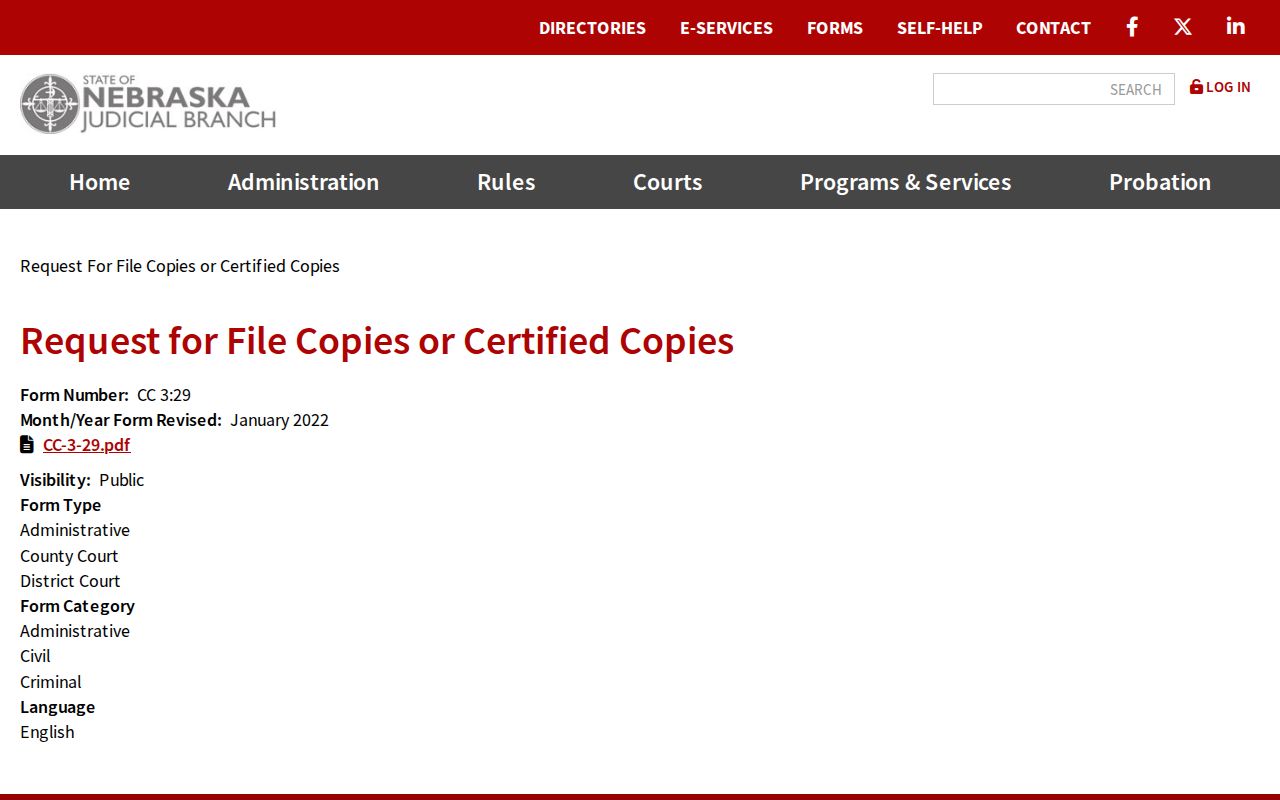
The form mainly organizes what you are asking for. The Dundy clerk still supplies the material and decides which public records can be released.
Dundy Court Records at One Counter
One counter in Dundy County handles the records. Pandora L. Garcia is listed locally as Clerk of District Court. The Judicial Branch swore her in as Clerk Magistrate and Ex-Officio Clerk of District Court. So a caller asking for the county-court clerk or the district-court clerk reaches the same office either way. The clerk keeps and indexes the files, hands out copies and certifications, and can walk you through request logistics. She does not rule on the case. A judge, not the clerk, decides sealing, continuances, and the merits.
Nebraska Court Rule § 2-215 opens another door. It allows public inspection of electronic court records at a trial-court terminal and at identified library terminals. Paper copies cost extra and come as a separate step. Terminal access earns its keep when a remote name search would sweep too broadly. It also helps when the docket entry needs a side-by-side check against the paper file. In short, the public-view rule lets you look for free. A paid copy is a second transaction entirely.
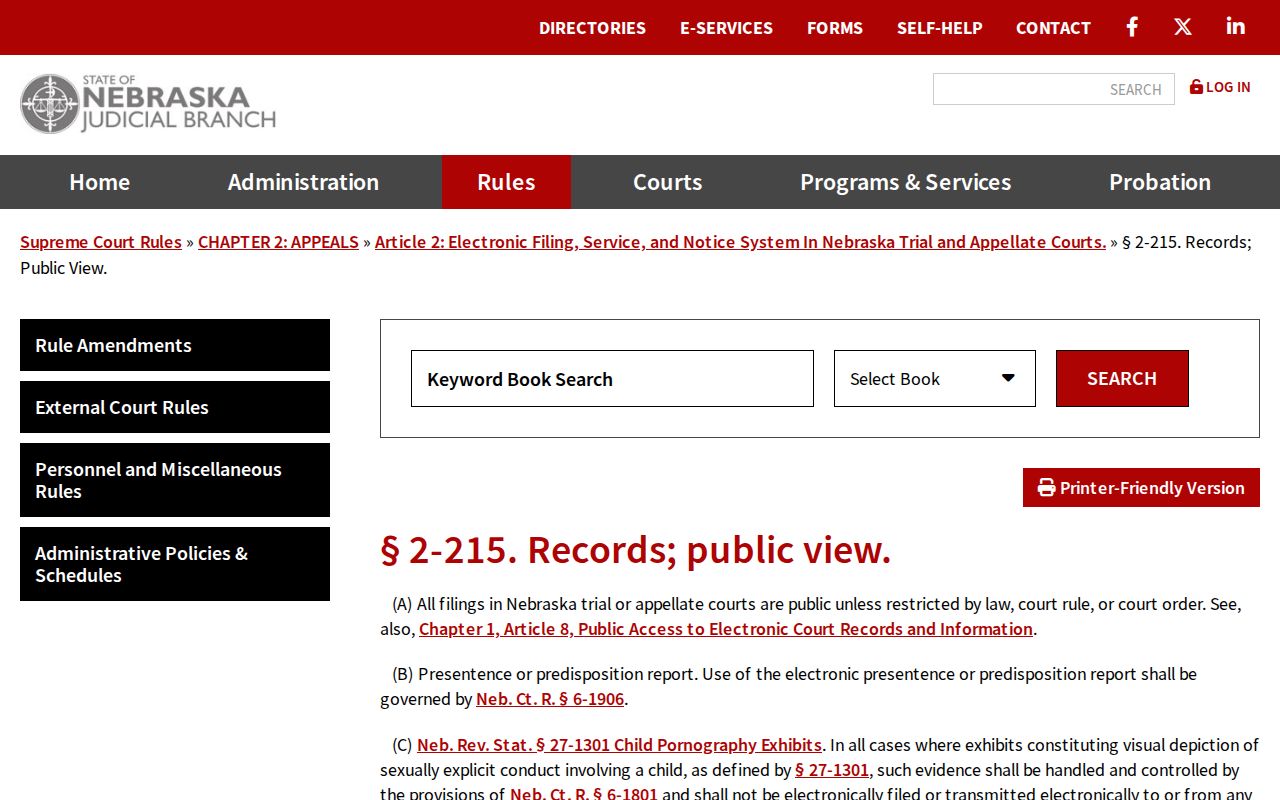
Bring case details, not a broad description. A narrow request gives the Dundy office a defined court record to pull, and it avoids asking staff to build a report that does not already exist.
Kinds of Court Records
A Dundy County court file is really several layers stacked together. One layer is the index, which names the case. Another is the register, a dated log of what has happened. A third is the set of filed papers itself. Financial or administrative entries may ride along too, depending on access rules. The clerk's public duties run wide. They cover criminal, civil, and mental-health records, along with dockets, judgments, writs, orders, filed papers, and service returns. The office also tracks court costs, fees, fines, restitution, and judgments. One caution applies. Just because a category appears in the office description does not mean every record in it is open without restriction.
- Case index and summary, including court, number, type, filing date, and status
- Register of actions, the date-ordered record of filings, settings, orders, and judgments
- Pleadings and filed documents, such as complaints, petitions, answers, motions, and returns
- Orders, judgments, writs, certificates, and satisfaction or financial records when releasable
- County-court digital audio or a typed transcript, when created, retained, and releasable
Got a case number handy? A Dundy County docket search can show the court level and the register entry before you order a copy.
Dundy Court Record Layers
A docket sheet is only part of the story. Think of the register of actions as a timeline. It tracks procedural events in the court record. It notes that a motion was filed, a hearing was set, or an order was entered. It does not reproduce every document behind those entries. An image may be missing too. Some filings predate imaging. Some stayed on paper, some were never uploaded, and some are restricted. Where images exist for the public, they generally cover records filed or uploaded after April 16, 2008.
Read any Dundy County case in order. Look for the date, the event label, any document link, the result, the next setting, and financial entries. Remember that "motion filed" is not "motion granted." A "hearing set" line is history, and a current calendar or a later order may have changed things since. That difference matters most when you need a certified judgment rather than a register printout.
Court Records: What They Contain
What you actually see depends on the case and its access status. Through JUSTICE, a case lookup may include a case summary, party listing, offense information where it applies, financial information, judge notes, the register of actions, and eligible document images. The original file can hold still more. Keep the full case number for any record request. Nebraska case numbers pack in the court level, county, case type, year, and sequence.
| Case identifier | Full Nebraska number, not just a final sequence; it identifies court level, county, type, year, and case. |
|---|---|
| Case summary | Court, type, filing date, status, and high-level subject information when public. |
| Register of actions | Chronological filings, notices, settings, orders, judgments, service, and related activity. |
| Document layer | Releasable complaints, petitions, answers, motions, orders, judgments, returns, and exhibits. |
| Financial and media layer | Public costs, fines, restitution, payments, certificates, digital audio, or a transcript when available. |
A caption or index entry only names the case. It proves nothing about guilt, and it does not show that a motion was granted. For the court's actual action, read the later order, the judgment, or the newest entry on the register.
Dundy Court Record Audio and Transcript
Audio and transcripts serve different needs in Dundy County court records. Digital audio of a county-court proceeding is requested through the Judicial Branch’s Ch6Art14App6 path. A transcript is different. It is a typed record of a county or district proceeding. It is requested through its own CC 1:14 path. Neither request promises that a recording or transcript still exists, is still retained, or can be released. Court audio alone is not an official verbatim transcript. Only a qualified transcription makes it one.
For either request, give the court, the case number, the proceeding date, and the judge. Also name the part of the hearing you want. Ask the clerk about availability, format, retention, and cost before assuming an old hearing can be supplied. An old Dundy file may be gone. If it was destroyed under a retention schedule, the Court Records Search Policy points to a disposition schedule and a form-letter route. Ask whether a last-known index entry, judgment, or certificate survives.
Copy Fees and Certification
Know what you are buying before you pay. A plain copy is just a reproduction for information. A certified copy carries the clerk’s certification as a true court record. Authentication or an extra certificate can take more steps. Under the current Nebraska schedule, photocopies run 25 cents per page. Certificates, seals, filing, and court costs are listed separately. The schedule sets no single docket-sheet fee. It promises no delivery method, so ask the current price of the exact item first.
| Requested item | Published amount | Request detail |
|---|---|---|
| Photocopy | $0.25 per page | Listed on the current Nebraska court cost schedule. |
| Plain register or image | Ask clerk | Availability and format determine the request. |
| Certified copy or certificate | Ask clerk | Certification and seal charges are separate schedule items. |
| Audio or transcript | Ask clerk | Availability, production, and copy type may affect the process. |
State the exact format you need before paying. A docket printout, a document image, a certified copy, an authenticated copy, a transcript, and a digital-audio copy are distinct requests, and local steps can differ for each.
Dundy County court records contact
112 W 7th Avenue
Benkelman, NE 69021
(308) 423-2374
Dundy Court Record Redaction Rules
Redaction is not erasure. A protected detail comes out of the public copy. But the unredacted original can stay available to authorized users. Nebraska Court Rule § 6-1464 covers birth dates, gender, Social Security numbers, financial-account numbers, and similar personal or financial information in civil court records. Just because an image is visible does not mean sensitive identifiers may be reused. The protected-information rule lists the categories. They must be excluded, separated, redacted, or access-controlled in public civil records.
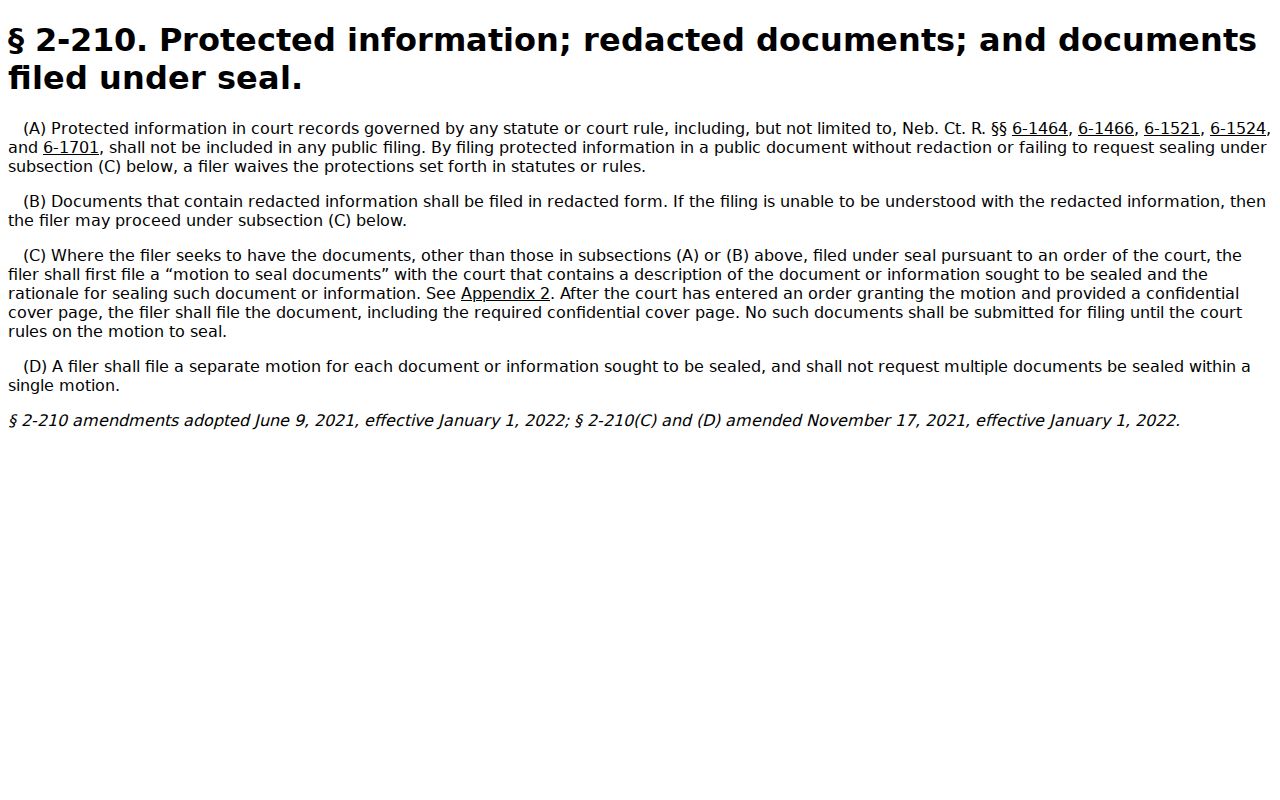
That rule does not open every other document to the public. Confidential statutes, court orders, and separate record rules can still limit a Dundy court record.
Access Rules for Court Records
Nebraska’s Public Records Act lets interested people examine public records and take notes or make copies during ordinary office hours, within statutory limits. Court-specific limits still matter. Juvenile matters, adoption records, sealed adult criminal records, some mental-health and child-welfare material, protected financial data, and exhibits sealed for good cause can all be restricted. A public search that comes up empty could mean the case sits in a different court, lives in an old paper file, reflects a search error, or is restricted. It does not prove no record ever existed.
Public access has defined limits. Neb. Rev. Stat. § 84-712 permits examination and copies of public records during office hours. Neb. Ct. R. § 1-805 describes electronic case information available to the public. Neb. Ct. R. § 2-210 governs motions and orders for sealing non-automatically protected material.
A public docket can list a sealing event while the document behind it stays closed. The restricted-records rule explains why.
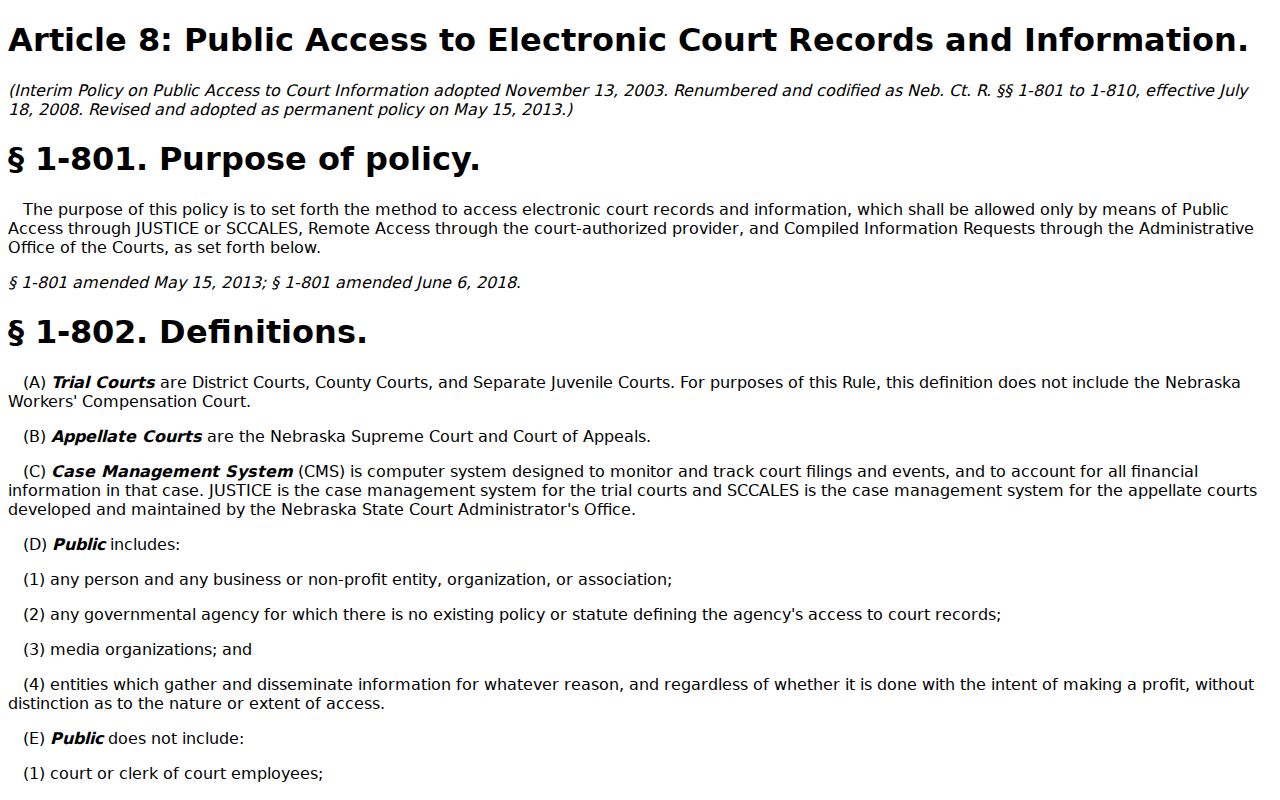
If an item is restricted, ask the clerk to name the withheld category or rule. Also ask whether a segregable redacted portion can be released. A sealed-record release request is not a shortcut around normal public-record limits.
Dundy Court Record Request Detail
A precise request gets routed faster. It beats one asking for everything about a person. Name the court level. Give the full case number, the case type, the filing year, a date range, and the item sought. Say whether you want a register, a particular filing, or a judgment. Audio, a transcript, or a certified copy works too. The clerk can hand over existing records and reasonably segregable nonrestricted portions. But the clerk is not required to create new analysis or a custom database. If a record cannot be located, ask why. It may be paper-only, un-imaged, held at the other court level, archived, destroyed under a retention schedule, or restricted. That question keeps apart an unavailable copy and a case that never existed.